
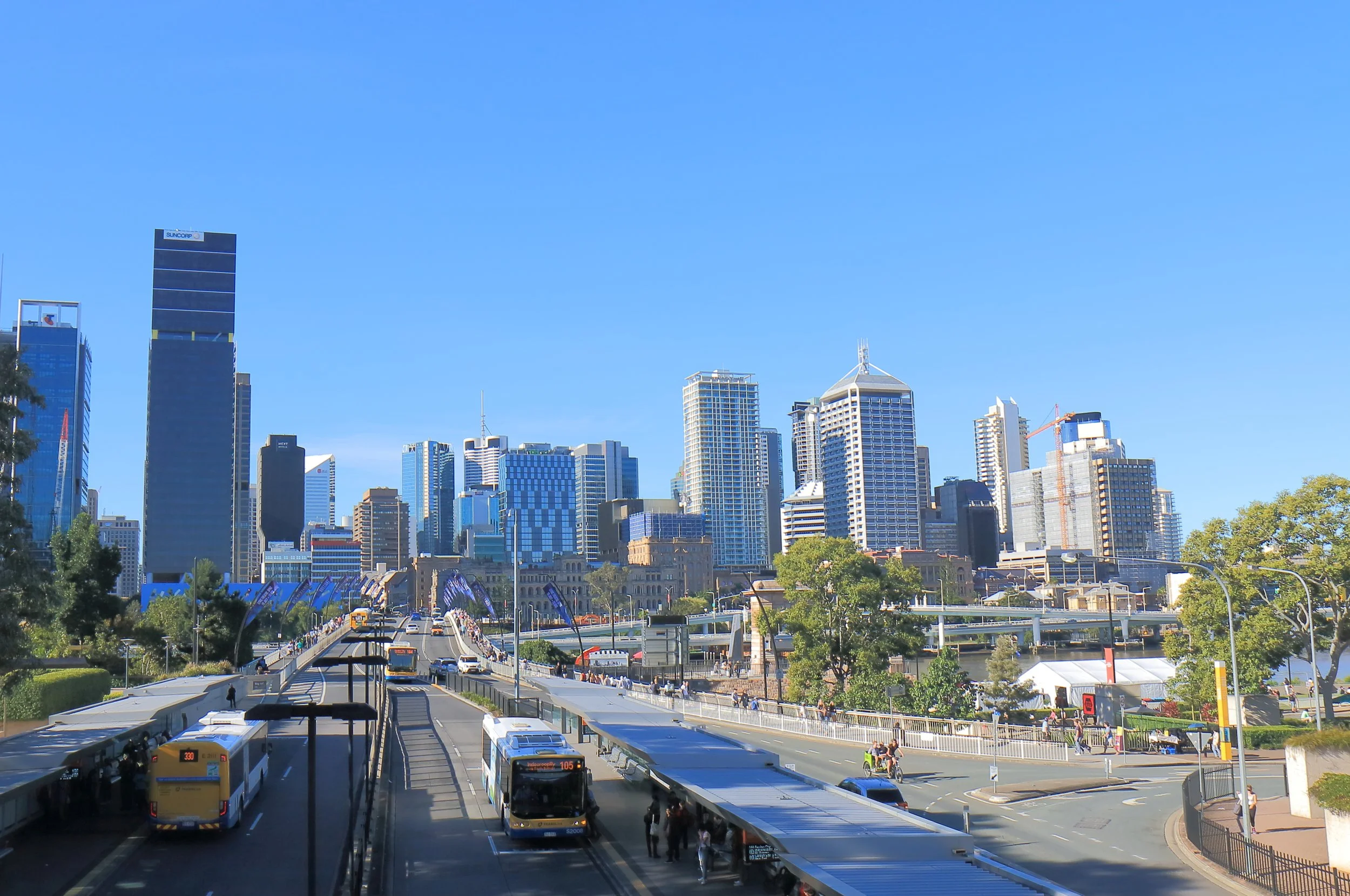
Visitor Guide · Brisbane 2032
Getting Around
Brisbane
Everything you need to know about getting from the airport, reaching venues, and moving around the city — without a car.
Last updated 16 June 2026 · By Toby Edmanson
What's the best way to get around Brisbane for the 2032 Olympics?
You don't need a car. From the airport, take the Airtrain — about 22 minutes to Central for ~$19. Around the city, get a Go Card and tap on to any train, bus or CityCat ferry; it's about 30% cheaper than cash and most venues are a short walk from a station. New rail (Cross River Rail) puts a station right beside the Gabba.
- Airport → city: Airtrain, ~22 min, ~$19 (~$17 on a Go Card).
- Get this first: a Go Card — works on train, bus, ferry and tram, with a daily cap.
- To the venues: nearly all are walking distance from a train station.
- Scenic + sometimes free: the CityCat ferry; the Kangaroo Point ↔ CBD ferry is free.
- Skip the hire car unless you're doing regional day trips.
Brisbane Airport (BNE) is 14km from the CBD. You have four options — the Airtrain is the easiest for most visitors.
Airtrain
Direct rail from the airport to Central Station, Roma Street, and South Brisbane. No transfers, no traffic. Runs every 15 min from early morning to late evening.
Rideshare / Taxi
Uber and taxis available from the Ground Transport Centre at the International and Domestic terminals. Good option late at night or if travelling with lots of luggage.
SkyGate Bus
Coach service connecting the airport to the CBD and South Bank. Cheaper than taxi but slower than Airtrain. Good if you're travelling with a group.
Hire Car
All major hire car operators are at the airport. Not recommended for getting into the CBD — but useful if you're heading straight to the Gold Coast or planning regional day trips.
Brisbane's public transport network covers the whole city. Get a Go Card and you can tap-on to any bus, train, ferry, or light rail without needing cash or tickets.
Go Card — Get This First
Brisbane's Opal/Oyster equivalent. Tap on and off at every station, bus stop, and ferry terminal. About 30% cheaper than single fares. Buy at the airport Airtrain station, Central Station, or 7-Elevens throughout the city.
CityCat Ferry
The most scenic way to move around Brisbane. 20 stops along the Brisbane River from UQ in the south to Northshore Hamilton in the north. Runs 7 days, early morning to late evening.
Buses
Extensive bus network covering suburbs not on the train line. Inner-city loop buses (City Loop, Spring Hill Loop) are free — no Go Card needed, just hop on.
Train Network
Nine lines radiating from Roma Street and Central Station. The best option for getting to venues quickly — most major venues are within walking distance of a station.
Every major Brisbane venue is reachable by public transport. Here's how to get to each one — no car needed.
Brisbane is the perfect base for day trips. Gold Coast, Sunshine Coast, and the hinterland are all under 1.5 hours — here's the easiest way to get to each.
Gold Coast
~1 hour · Train or car
Take the direct train from Roma Street or Central to Surfers Paradise or Broadbeach — the Gold Coast line runs regularly. By car, take the M1 motorway south. Fastest option early morning before traffic.
Lone Pine Koala Sanctuary
~30 min · Ferry or bus
Take the MiCat ferry cruise from North Quay (near CBD) — it's a scenic 1hr river journey that's part of the experience. Or catch bus 445 from the Cultural Centre.
Australia Zoo (Sunshine Coast)
~1.5 hours · Train + shuttle
Train from Roma Street to Beerwah on the Sunshine Coast line (~1hr 20min), then the Zoo's own shuttle bus from Beerwah station. Easy with kids — the shuttle is free with ticket purchase.
Glass House Mountains
~1 hour · Car recommended
The volcanic peaks north of Brisbane — dramatic for photos, with great walking tracks. Hire a car or join a day tour. Not practical by public transport.
Brisbane is investing heavily in transport infrastructure ahead of 2032. Here's what's confirmed, what's planned, and what it means for visitors.
Cross River Rail
New underground rail tunnel beneath the Brisbane River — connecting Dutton Park (near the Gabba) to Bowen Hills. Opened 2025. Reduces journey times across the city and adds four new underground stations, including one directly serving the Gabba precinct.
Impact: Major improvement for venues near WoolloongabbaBrisbane Metro
High-frequency bus rapid transit (BRT) network running through tunnels under the CBD. Two lines connecting Eight Mile Plains to Roma Street and Royal Brisbane Hospital. Significantly improves inner-city frequency.
Impact: Better connections between South Bank, Gabba and CBDGames-Period Venue Shuttles
Dedicated shuttle services will connect major transport hubs to venues that are harder to reach by rail (Chandler, Redland). Exact routes and operating hours TBC closer to 2032.
Impact: Removes the need for a hire car to reach outlying venuesAirport Link Capacity Increase
Airtrain frequency upgrades being assessed to handle Games-period passenger volumes. May increase to every 10 min during peak Games days.
Impact: Faster airport clearance during busy arrival/departure daysWoolloongabba Station (Cross River Rail)
The new underground station at Woolloongabba will be steps from the Gabba — making it the most connected Olympic stadium in history. Station design and exact entrance locations still being finalised.
Impact: Walking-distance rail access to the main Olympic stadiumQuick answers
Brisbane 2032 transport: FAQ
How do I get from Brisbane Airport to the city for the 2032 Olympics?
The Airtrain is the easiest option for most visitors — direct rail to Central Station in about 22 minutes, running every 15 minutes, for roughly $19 (about $17 with a Go Card). A taxi or rideshare costs about $45–$65 and takes 25–40 minutes depending on traffic.
Do I need a car for the Brisbane 2032 Olympics?
No. Brisbane's train, bus and CityCat ferry network reaches every major venue, and most central venues are within walking distance of a station. A car is only worth it for regional day trips. For the city and the venues, a Go Card is faster and cheaper.
What is a Go Card and do I need one?
The Go Card is Brisbane's tap-on travel card — the equivalent of London's Oyster or Sydney's Opal. It works on trains, buses, ferries and trams, is about 30% cheaper than cash fares, and has a daily fare cap. Buy one at the airport Airtrain station, Central Station, or any 7-Eleven for $10, including $5 of travel credit.
How do I get to Brisbane 2032 venues by public transport?
Most venues are a short walk from a train station: Suncorp Stadium is 5 minutes from Roma Street, the Gabba is near South Brisbane and the new Woolloongabba station, and the Queensland Tennis Centre is 2 minutes from Tennyson station. Outer venues like Chandler are reached by bus, with Games-period shuttles planned.
Is public transport free during the Brisbane 2032 Olympics?
It hasn't yet been confirmed. At recent Games, an event ticket typically included free public transport on the day of the event, but Brisbane 2032 organisers have not confirmed their arrangement. Until then, plan to travel on a Go Card.
What new transport is being built for Brisbane 2032?
The biggest project is Cross River Rail, an underground line with a new Woolloongabba station steps from the Gabba. Brisbane Metro adds high-frequency bus rapid transit through the CBD, and Games-period shuttles are planned to reach outlying venues like Chandler and Redland.